


Digital marketing has changed dramatically over the last few years. Not long ago, a marketer’s everyday toolkit could be summed up pretty simply: Google for search, Gmail for communication, Google Ads and Meta Ads for paid campaigns, WordPress for websites, Google Analytics for measurement, and Excel or Sheets for reporting. Today, the digital marketing toolkit looks very different.
AI has moved from being an interesting experiment to becoming part of the everyday marketing workflow. Marketers can now use AI to research markets, generate ideas, create content, analyse data, automate repetitive tasks, build websites, optimise campaigns, and even support customer interactions.
But having more tools doesn’t automatically make you a better marketer. The real advantage comes from knowing which tool to use, when to use it, and where human strategy still matters.
So, let’s look at what the modern digital marketing toolkit looks like in 2026.
1. Research & Strategy: From Searching to Thinking With AI
Research has always been at the heart of marketing. Before creating a campaign, you need to understand your audience, competitors, industry, customer pain points, and market trends.
Traditionally, marketers would spend hours searching Google, opening dozens of websites, and manually organizing information.AI has changed that workflow.
Tools to Explore:
- ChatGPT – research, brainstorming, content planning, analysis and strategic thinking
- Claude – writing, analysis and working with large amounts of information
- Gemini – research, brainstorming and working across Google’s ecosystem
- Perplexity – research and source-backed answers
These tools can help you move from a vague question to a structured research process much faster. For example, instead of asking:
“Give me some Instagram post ideas.”
You could ask: “I run a skincare brand targeting Indian women aged 25 – 40. Analyse the major content themes in this category, identify common customer concerns, and suggest 5 content pillars that could differentiate the brand.”
The difference isn’t just the tool. It’s the quality of the thinking and prompting behind the tool. AI can accelerate research, but marketers still need to validate information, understand context, and make the final strategic decisions.
2. Content Creation: AI as Your Creative Assistant
Content is still one of the biggest parts of digital marketing.
Blogs, social media posts, advertisements, emails, scripts, newsletters, landing pages, and video content all require ideas and execution.
AI can now help with almost every stage of the content process. You can use AI to:
- Brainstorm content ideas
- Create content outlines
- Repurpose long-form content
- Develop social media captions
- Write video scripts
- Improve headlines
- Generate content variations
- Adapt messaging for different audiences
- Turn one piece of content into multiple formats
Tools such as ChatGPT and Claude can be particularly useful during the ideation, drafting and editing stages. OpenAI, for example, describes writing use cases including drafting, rewriting, adjusting tone and organizing ideas.
But there’s a catch.
AI can produce content quickly. It doesn’t automatically produce good marketing. If every brand uses AI to create the same generic content, audiences will eventually stop paying attention.
That’s why your expertise, opinions, examples, storytelling, and brand voice matter more, not less. AI gives you speed. You provide the direction.
3. Design & Visual Content: From Blank Canvas to Creative Collaboration
Design used to require specialised software and considerable technical knowledge. Today, tools such as Canva and Figma make visual content much more accessible, while AI is increasingly becoming part of the creative workflow. Canva has been expanding its AI capabilities significantly in 2026, including conversational creation and editable, layered designs.
For marketers, this means you can use AI-assisted design to create:
- Social media creatives
- Ad concepts
- Presentations
- Infographics
- Thumbnails
- Marketing documents
- Campaign concepts
- Brand assets
But again, the tool isn’t the strategy. A beautiful graphic with the wrong message is still a bad marketing asset. The marketer’s job is to understand:
Whom are we talking to? What do we want them to feel? What action should they take? Why should they care?
4. Websites & Landing Pages: Building Faster
Web development is another area where AI is changing the marketing workflow. Tools such as WordPress continue to be important for website management, while newer AI-assisted website builders can help marketers turn ideas into landing pages and websites faster.
This can be particularly useful for:
- Campaign landing pages
- Lead-generation pages
- Product pages
- Portfolio websites
- Small-business websites
- MVP websites
The advantage isn’t necessarily that marketers no longer need developers. Instead, marketers can move faster from:
Idea → Prototype → Landing Page → Test
That means marketing teams can validate ideas before investing significant time and resources into development.
5. SEO Is Evolving Into AI Search
SEO isn’t disappearing. But the way people discover information is changing. People are increasingly interacting with search engines through AI-powered experiences, including Google’s AI Overviews and AI Mode.
Google has also introduced Search Console reporting designed to help some site owners understand visibility within generative AI features in Search and Discover. This creates a bigger question for marketers:
How do we make our content discoverable when people aren’t always clicking through a traditional list of blue links?
This is where concepts such as AEO (Answer Engine Optimisation) and GEO (Generative Engine Optimisation) have gained attention.
But don’t make the mistake of thinking that traditional SEO is dead.
Google’s own guidance continues to emphasize valuable, unique content and says that established SEO fundamentals remain important for generative AI experiences.
In practical terms, marketers should focus on:
- Creating genuinely useful content
- Answering real customer questions
- Demonstrating expertise and experience
- Building topical authority
- Maintaining strong technical SEO
- Optimizing pages for humans first
- Creating original insights rather than rewriting what everyone else has already said
The future of search isn’t simply about adding more keywords. It’s about becoming the best answer.
6. Paid Marketing: AI Is Entering the Advertising Engine
Google Ads and Meta Ads aren’t disappearing either. But campaign management is becoming increasingly automated and AI-driven.
Google’s 2026 marketing announcements show how deeply AI is being integrated into advertising, including new AI-powered Search experiences, creative tools and campaign optimization capabilities.
For marketers, this changes the role of campaign management. Previously, a large part of the work involved manually adjusting bids, audiences, placements and campaign settings. Automation can now handle more of those tasks.
That means marketers increasingly need to focus on:
- Strategy
- Offer
- Audience understanding
- Creative direction
- Messaging
- Conversion experience
- Data interpretation
- Testing
In other words: The platform may optimise the campaign, but you still need to know what you’re trying to achieve.
7. Automation: Stop Doing the Same Task Manually
One of the biggest opportunities in modern marketing isn’t content generation. It’s automation. Imagine this workflow:
Someone fills out a website form.
- Their information enters your CRM.
- They receive an email.
- The sales team gets notified.
- The lead is categorised.
- The information is added to a spreadsheet.
- A follow-up task is created.
- A few years ago, much of this could require manual work or custom development.
Today, platforms such as Zapier and Make can connect different applications and automate workflows. Zapier, for example, now positions itself as infrastructure for AI-powered automation and supports workflows connecting thousands of applications.
The opportunity for marketers is huge. Instead of asking: “What can AI write for me?” Start asking: “What repetitive marketing work can I stop doing manually?”
That’s a much more powerful question.
8. Analytics: Data Still Matters
AI may be changing marketing, but one thing hasn’t changed:
You still need data.
Google Analytics, Google Search Console, advertising platforms, and reporting tools remain essential for understanding what’s happening. You need to know:
- Where your traffic comes from
- Which campaigns generate leads
- Which content performs best
- Which pages convert
- How customers behave
- Where your marketing budget is going
- What is actually contributing to business growth
The difference is that AI can increasingly help marketers interpret this information faster. Instead of spending hours staring at spreadsheets, marketers can use AI-assisted analysis to identify patterns, summarize findings, and generate questions for further investigation.
But don’t let AI become a substitute for understanding your numbers. If you don’t understand the data, you can’t judge whether the AI’s conclusion makes sense.
9. Social Media: More Content Isn’t the Goal
Social media is perhaps where the biggest temptation to overuse AI exists. You can now generate hundreds of captions, images, scripts, and content ideas in a fraction of the time.
But that doesn’t mean your audience wants hundreds of posts. They want something worth stopping for. The most effective social media strategy in 2026 is likely to combine:
AI-powered efficiency + human creativity + genuine brand personality.
Use AI to:
- Generate ideas
- Repurpose content
- Create variations
- Analyse performance
- Build content calendars
- Speed up production
But use human judgment for:
- Opinions
- Storytelling
- Brand personality
- Cultural context
- Humor
- Community interaction
- Authentic experiences
Because when everyone’s using AI to create content faster, being interesting becomes even more valuable.
10. Collaboration & Productivity: The Marketing Team’s New Workspace
Marketing rarely happens in one application. A campaign may involve a marketer, designer, copywriter, video editor, sales team, and client. Tools such as Notion, Slack, Loom, and project-management platforms help teams collaborate, document information, and communicate.
AI is increasingly being added to these workflows as well. The goal isn’t simply to create more meetings or more documents. It’s to reduce the friction between:
Idea → Execution → Feedback → Improvement
That’s what a modern marketing technology stack should ultimately do.
So, What Does a Digital Marketer Actually Need in 2026?
Here’s the important part. You don’t need 50 subscriptions. You don’t need to learn every AI tool that launches. And you definitely don’t need to use AI simply because everyone else is using it.
A practical marketing toolkit could start with:
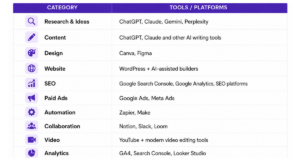
The exact tools will change. New platforms will appear. Existing platforms will add new AI capabilities. Some tools that are popular today may be replaced tomorrow.
That’s why tool collecting shouldn’t be your strategy.
The Real Marketing Toolkit Is Still You
This may sound strange coming from an article about AI tools, but it’s the most important lesson. AI can help you research faster. It can help you write faster, design faster, automate faster, and analyse faster.
But it doesn’t automatically know: Why should your customer choose you?
That’s still a marketing problem. And solving that requires positioning, psychology, creativity, customer understanding, experimentation, and strategic thinking.
There is also a growing concern around low-quality, repetitive AI-generated content. Canva’s 2026 marketing research highlights a similar tension: AI is increasing creative speed, but human direction, taste, and judgment remain important differentiators.
So perhaps the biggest shift in marketing isn’t: Humans vs AI. It’s: Marketers who use AI effectively vs marketers who don’t.
The digital marketing toolkit of 2026 is bigger, smarter, and more connected than ever before. But the goal isn’t to use every new tool. The goal is to build a marketing system in which technology helps you spend less time on repetitive tasks and more time on what actually creates value.
Research better. Create smarter. Automate repetitive tasks. Measure what matters. Understand your audience.
And most importantly, think like a marketer, not like a tool user, because tools will keep changing. Good marketing principles won’t.
If you’re a business owner, freelancer, marketer, or creator, don’t try to learn every tool at once. Pick one tool for research, one for content, one for design, one for analytics, and one for automation.
Master your workflow first. Then expand your toolkit when you actually have a problem to solve. That’s the 2026 way to do digital marketing.
Leave A Comment